
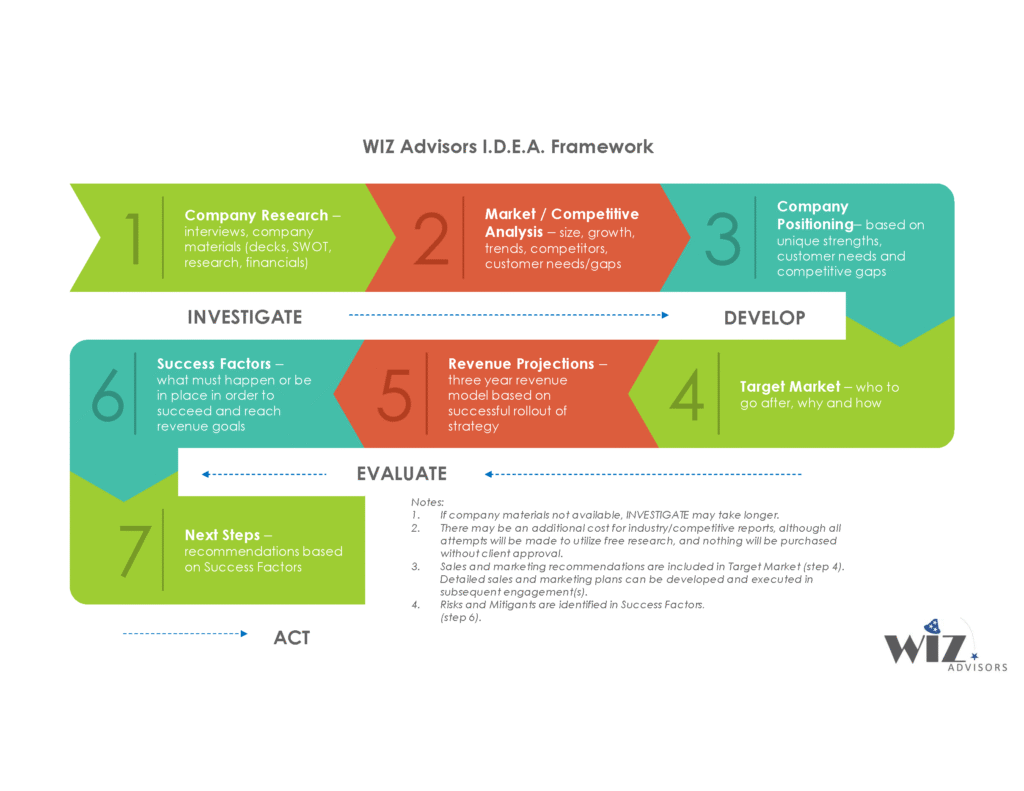
Eight years ago, when I launched WIZ Advisors, I developed a framework for building foundational go-to-market strategies for my clients.
A lot has changed since then.
Marketing technology exploded. Account-based marketing took off. Customer data platforms arrived. Intent data became mainstream. Generative AI transformed how we create and analyze information. And now AI agents are beginning to execute work that previously required entire teams.
This past weekend, I went back and looked at the framework I created in 2018. And something struck me.
I would not change the fundamental structure.
The technology surrounding marketing has changed dramatically, but the core strategic questions haven’t.
My original framework – which I named the IDEA Framework – follows four stages:
INVESTIGATE → DEVELOP → EVALUATE → ACT
The process moves from company, market, and competitive research through positioning and target-market decisions, revenue projections, success factors and ultimately recommendations and action.
The biggest change today is our ability to use AI throughout the process.
But rather than replacing the framework, I augment it.
Here is what the IDEA framework looks like today.
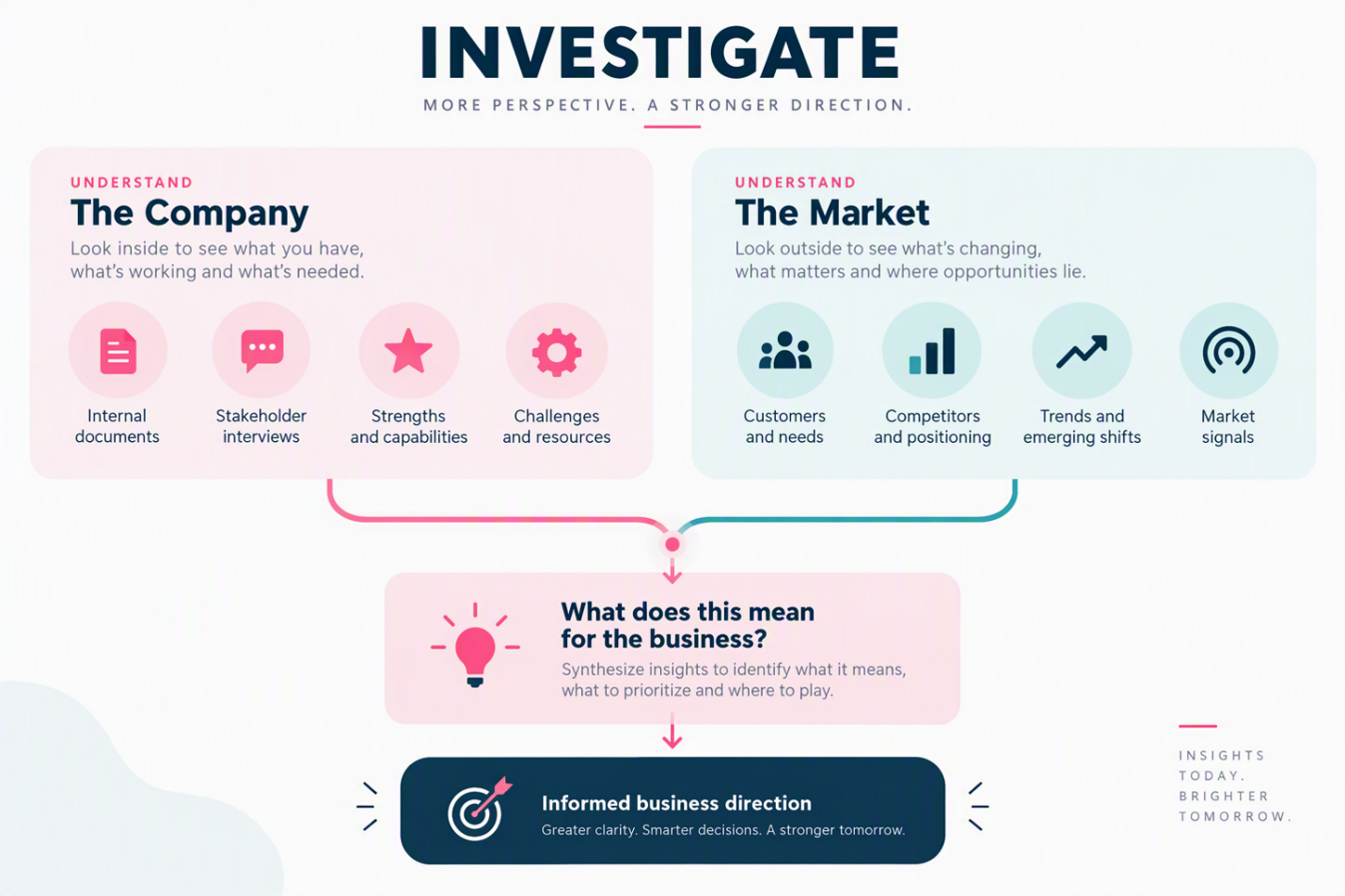
1a) INVESTIGATE: Understand the Company
Strategy begins with the foundations.
WIZ Advisors’ IDEA framework starts with company research, including interviews, company materials, presentations, SWOT analysis, research and financial information.
Before deciding what marketing should do, we need to understand what the company is trying to accomplish, what it does exceptionally well, where it struggles, and what resources it has on hand to meet its objectives.
Where AI helps: AI can analyze interviews, summarize internal documents, identify recurring themes, compare stakeholder perspectives and synthesize large amounts of qualitative and quantitative information.
Humans still determine what matters. AI just increases how much evidence we have to consider.
1b) INVESTIGATE: Understand the Market
The second component is market and competitive analysis: market size, growth, trends, competitors and unmet customer needs or gaps.
That hasn’t changed either.
What has changed is the speed and depth at which we can conduct the analysis.
Where AI helps: AI-assisted research can accelerate competitor analysis, synthesize industry research, analyze customer reviews and conversations across the web, identify emerging themes, compare competitor messaging and uncover potential whitespace.
Instead of spending days digging through information, strategic marketers can spend more time asking the harder question:
What does all this mean for the business?
2a) DEVELOP: Establish Your Positioning
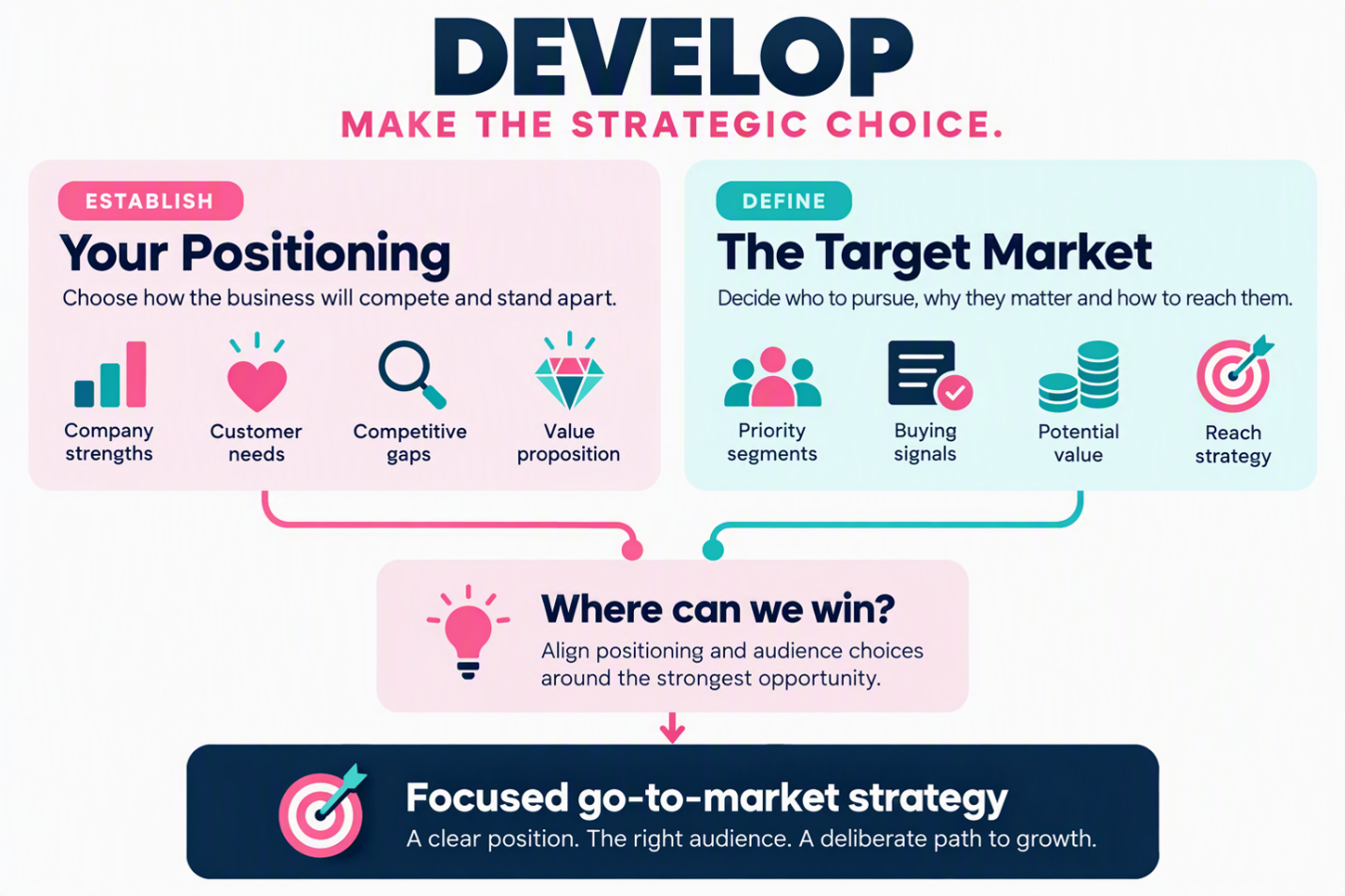
Once you understand the company, the competition, and the market, you can create a strong value proposition.
The IDEA framework defines positioning as the intersection of unique company strengths, customer needs, and competitive gaps, all of which you outlined in step 1.
Where AI helps: AI can analyze competitor strengths, mine communities like Reddit and Facebook Groups for customer insights, develop positioning alternatives and pressure-test value propositions against customer personas.
Important to note, AI performs the analysis, but does not determine your positioning. Positioning is a strategic choice.
2b) DEVELOP: Define the Target Market
Next comes one of the most important questions in any growth strategy:
Who are we going after, why are we going after them, and how are we going to reach them?
While that hasn’t changed, today we have exponentially more data available to answer that question.
Where AI helps: AI can analyze CRM data, firmographics, behaviors, intent signals, customer profitability, buying patterns and funnel statistics to identify segments and buying signals.
In 2026, a significant shift is occurring à we are moving from traditional ICP scoring toward decisioning architecture.
Instead of simply asking, “Does this company fit our ICP?” we can increasingly ask:
What do we know about this account, what signals are changing, what is the potential value, and what should we do next?
Those answers are much more powerful.
3a) EVALUATE: Build the Revenue Model
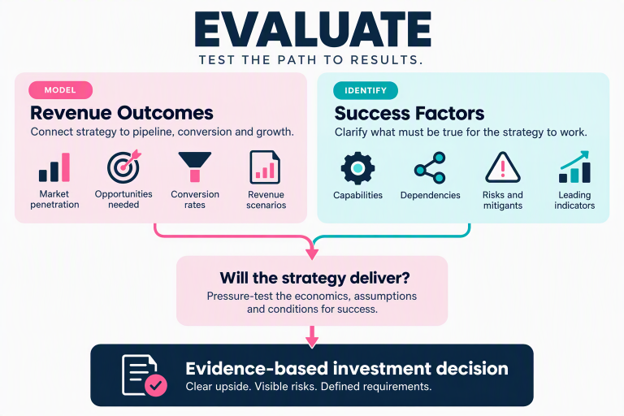
Ultimately, marketing strategy must connect to business outcomes.
The IDEA framework therefore includes three-year revenue projections based on the successful rollout of the strategy.
That forces strategy out of the realm of attractive presentations and into economics.
What happens if we penetrate this market? How many opportunities do we need? What conversion rates are required? What does that mean in terms of pipeline and revenue?
Where AI helps: AI can accelerate revenue modeling, sensitivity analysis and forecasting. It can help teams explore best-case, expected, and downside scenarios and identify the variables with the greatest impact on results. That makes the revenue model much more useful as a decision-making instrument.
3b) EVALUATE: Identify the Success Factors
Then comes the part many organizations skip.
What must be true for this strategy to work?
These are called success factors or the capabilities, conditions and actions that must be in place to reach the revenue goals.
Risks and mitigants are also identified at this stage.
Maybe the strategy requires better data.
Maybe sales and marketing need tighter alignment.
Maybe the company lacks sufficient content across the buyer’s journey.
Maybe the CRM isn’t structured correctly.
Maybe the team doesn’t have the resources required to execute.
These aren’t implementation details. They’re strategic dependencies.
Where AI helps: AI can help identify dependencies, detect gaps, model risk scenarios, prioritize initiatives and monitor leading indicators that tell us whether the strategy is working.
This is also where human judgment becomes particularly important.
AI can surface the risk. Leadership must decide which risks the organization is willing to accept.
4) ACT: Turn Strategy into Execution
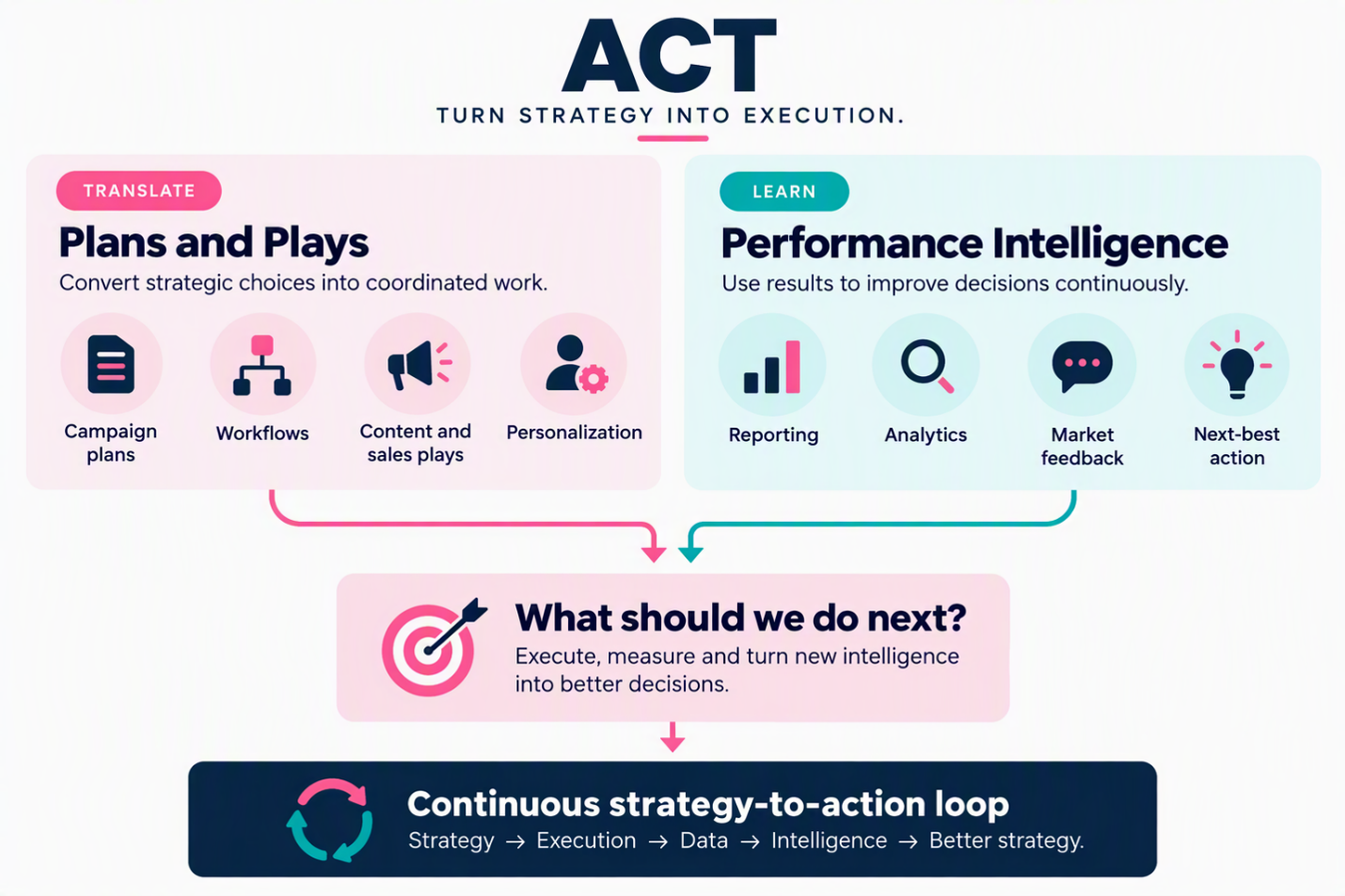
Finally, strategy must turn into action.
The IDEA framework ends with recommendations and next steps based on the success factors.
Where AI helps: AI can help translate strategy into campaign plans, workflows, content, sales plays, personalization, reporting, analytics and agentic execution. It can also continuously analyze performance and feed new intelligence back into the strategic process.
This creates a loop:
Strategy → Execution → Data → Intelligence → Better Decisions → Better Strategy → Better Execution
And that’s where AI becomes extraordinarily powerful.
What AI Changes, and What It Doesn’t
Looking at my eight-year-old strategy framework through the lens of AI reinforces something I believe strongly today:
AI does not eliminate the need for strategy. It increases the cost of not having a good one.
Why? Because AI accelerates execution.
If the positioning is wrong, AI will produce the wrong message faster.
If you’re targeting the wrong market, AI can help you reach more of the wrong prospects.
If your underlying assumptions are flawed, AI can automate decisions based on those flawed assumptions at enormous scale.
Speed isn’t particularly useful when you’re headed in the wrong direction.
The organizations that win with AI won’t simply be the organizations with the most AI tools. They’ll be the ones that connect strategy, intelligence, decisioning and execution into a coherent system.
Eight Years Later, I’m Still Using the Framework
Would I execute this framework differently today?
Absolutely.
I’d use AI extensively throughout every stage. I’d incorporate more data. I’d build continuous feedback loops. I’d automate research and analysis that used to take days or weeks. I’d create decisioning systems that continuously evaluate what the organization should do next.
But I wouldn’t throw away the strategic foundation:
INVESTIGATE → DEVELOP → EVALUATE → ACT
The technology may have changed. The speed may have changed. The amount of intelligence available to us may have changed.
But the fundamental role of marketing strategy has not.
Understand where you are. Decide where you can win. Determine what it will take to get there. Then execute relentlessly.
Want to discuss how the IDEA Framework could be implemented in your business?
Reach out to us on our Contact Us page and we’ll set up a time to chat.