
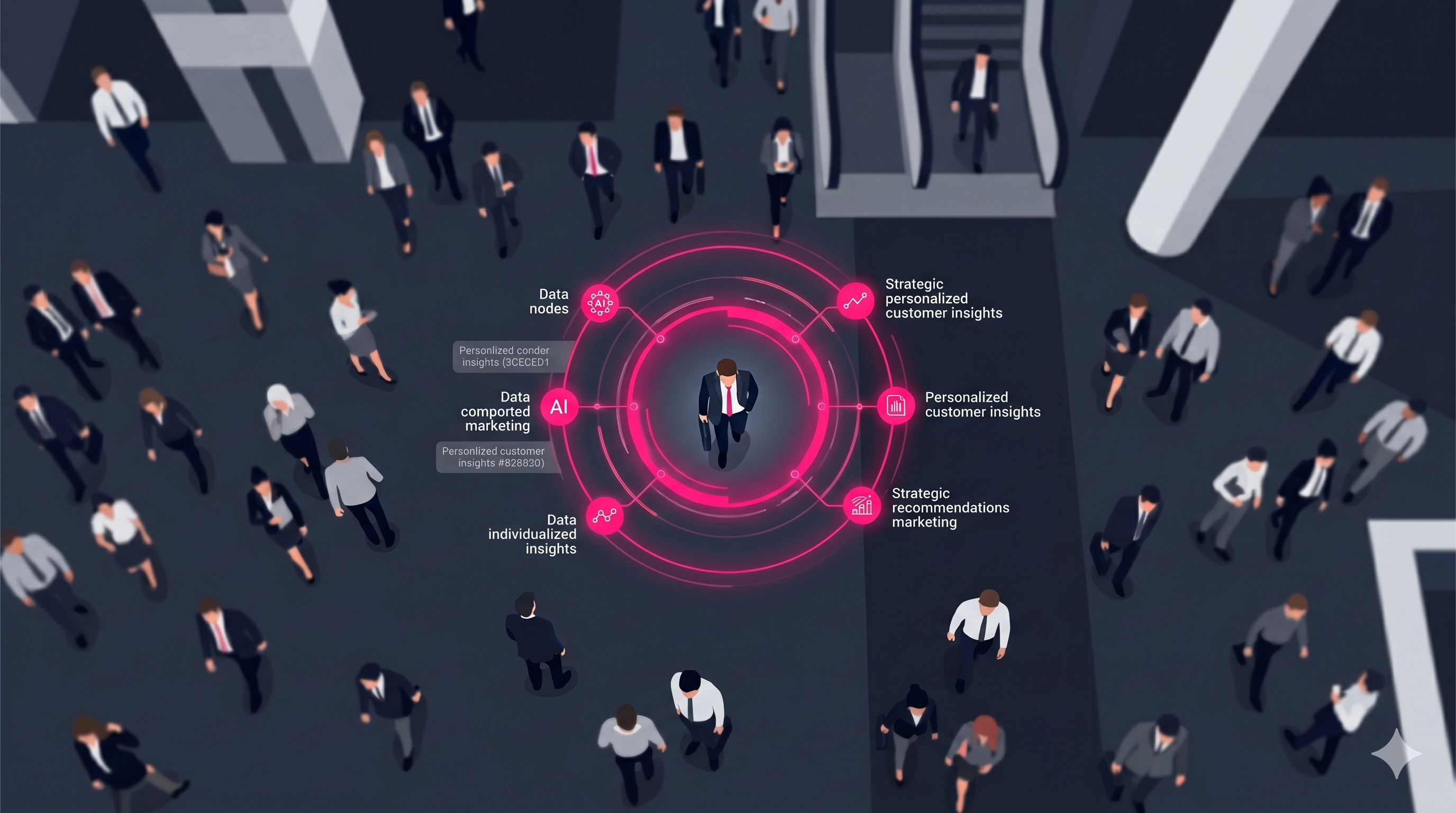
Marketing to everyone is marketing to no one.
In 2026, customers expect brands to know them—sometimes better than they know themselves. From Netflix’s uncanny ability to queue the perfect next binge to e‑commerce experiences that surface exactly the product you’re looking for, hyper‑personalization has become the standard.
This blog explores how artificial intelligence enables true one‑to‑one marketing at scale—and why leaders who embrace it will win.
The Shift from Mass Marketing to the Segment of One
Remember when marketing felt like throwing darts blindfolded? Brands blasted the same message to everyone and hoped something stuck.
Those days are over.
Today’s consumers ignore generic outreach. Relevance earns attention—whether that’s a product they’ve been considering, content that addresses their exact challenge, or an offer delivered at precisely the right moment.
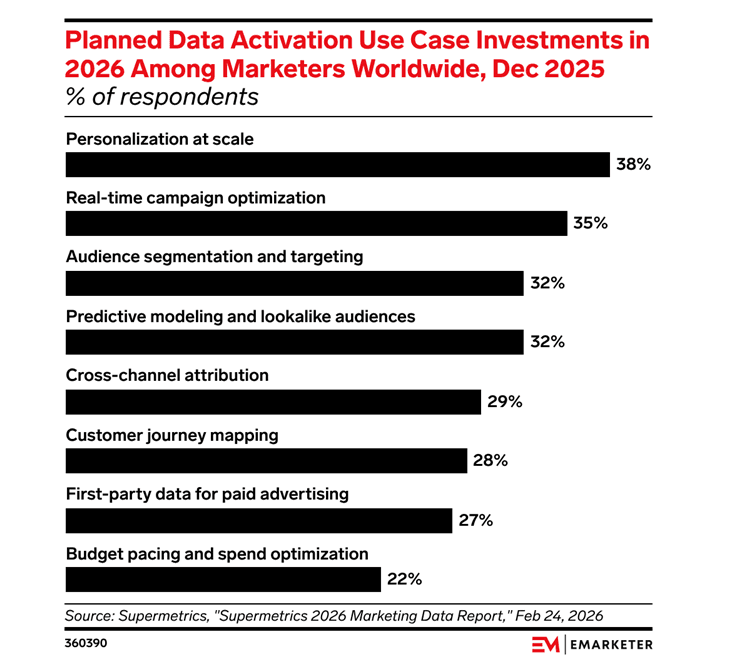
The chart below from eMarketer shows how personalization at scale has become the #1 focus for marketers worldwide. However, execution is lagging well behind intent. 42% of brand marketers and 47% of agency marketers in North America cite limited platform integration as their top barrier to personalization.
AI makes this transformation possible by analyzing behavior, predicting intent, and personalizing experiences in ways humans never could at scale.
Welcome to the era of the segment of one—where every customer interaction is uniquely tailored. You don’t have to be Netflix or Amazon with a huge data science team to deploy these capabilities. Small to mid-size businesses can do the same things through AI personalization tools.
This isn’t about inserting a first name into an email anymore. It’s about dynamic, real‑time experiences that adapt to behavior, context, and predictive signals.
Why AI‑Driven Personalization Matters to the C‑Suite
The Business Case for Personalization
Here are four statistics that make the case for hyper-personalization in 2026.
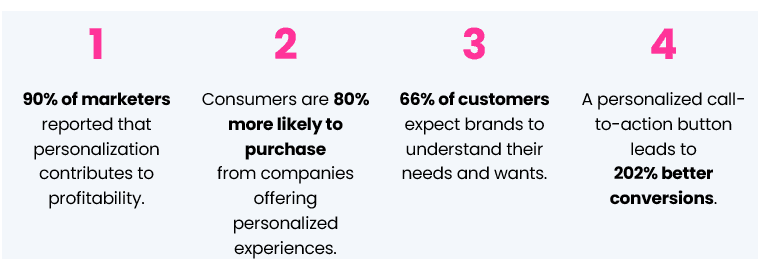
Source: Demand Sage, April 2026
AI enables marketers and sales teams to target the right person with the right message at the right time—maximizing return on every dollar spent.
In competitive landscapes with rising acquisition costs and shrinking attention spans, personalization isn’t a nice‑to‑have – it’s survival.
Examples of AI‑Powered Personalization in Action
Numbers tell you personalization works. Examples show you how.
Below are four ways AI-powered personalization is showing up in the market right now, as live tactics reshaping how customers experience brands today.
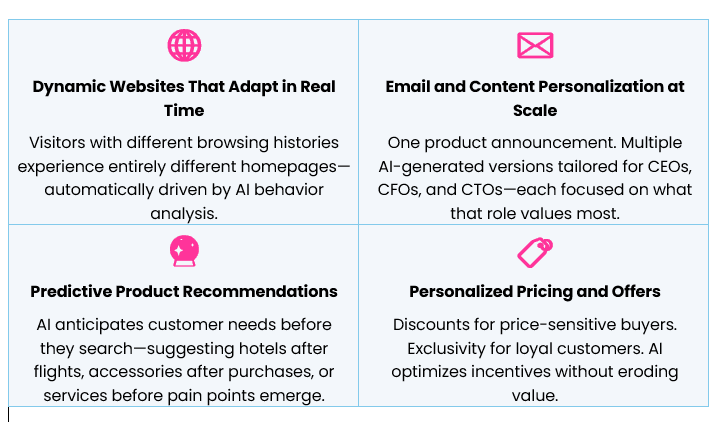
Case Study: AI Personalization in the Real World
Recent B2B Hyper‑Segmentation Success
Last month, we led a personalized email campaign for a client using HubSpot’s email marketing, segmentation, and smart content tools.
Compared to mass email with no personalization, we saw open rates double and click-through rates hit as high as 96%!
Here’s how we did it:
- We looked at the client’s email history and pulled a list of 600 contacts who had opened a marketing email in the last 6 months.
- Then we separated it by industry.
- Then we cut each industry segment in half to test different email formats.
- Then finally, we went back and categorized each contact by role – revenue leader, marketer, or operations leader. We used “smart content” to swap the email copy by role to deliver personalized messaging for each role’s speciric pain points.
Not only did our strategy increase open and click rates, but at the end of the campaign, we identified a small group of 40 contacts that were highly interested and ready for sales follow-up.
That’s impactful marketing.
How Predictive Analytics Supercharges Personalization
Personalization becomes truly powerful when it turns proactive.
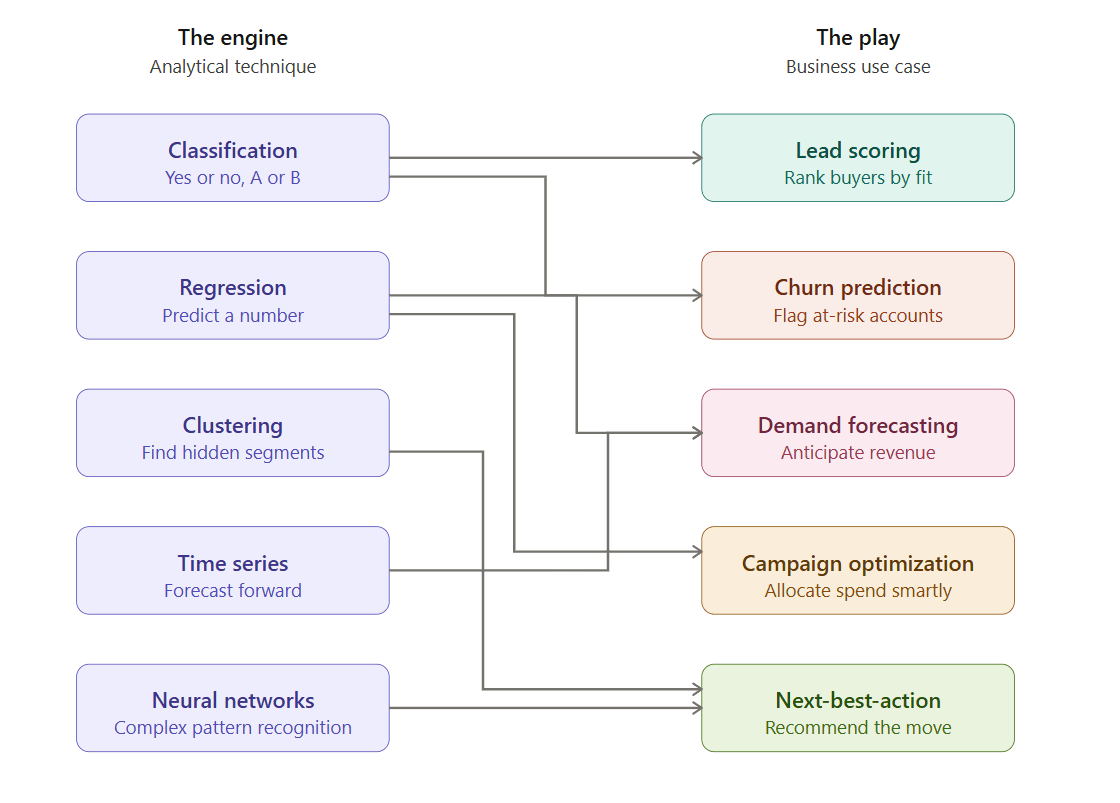
Below are five predictive use cases used most often in marketing:
- Lead scoring and prioritization
- Churn prediction
- Demand forecasting
- Campaign optimization
- Next‑best‑action recommendations
These use cases are driven by five recognized analytical techniques:
- Classification models — Assign records to discrete categories (buyer vs. non-buyer, churn vs. retain). This is the workhorse behind most lead scoring and churn systems.
- Regression models — Predict a continuous numeric outcome (deal size, lifetime value, monthly demand). These power forecasting and revenue planning.
- Clustering models — Group similar records together without predefined labels to surface hidden segments. Useful for persona discovery and account tiering.
- Time series models — Forecast values forward based on historical patterns, seasonality, and trend. The foundation of demand forecasting and pipeline projections.
- Neural networks and deep learning — Detect complex, non-linear patterns across large, messy datasets. Increasingly used for next-best-action engines and multi-touch attribution where simpler models can plateau.
Challenges and Ethical Considerations
Personalization requires that companies gather data on their prospects and customers and make sure it is clean and accurate. We recommend that our clients audit their contact data monthly to make sure that emails/jobs haven’t changed, because they do – regularly.
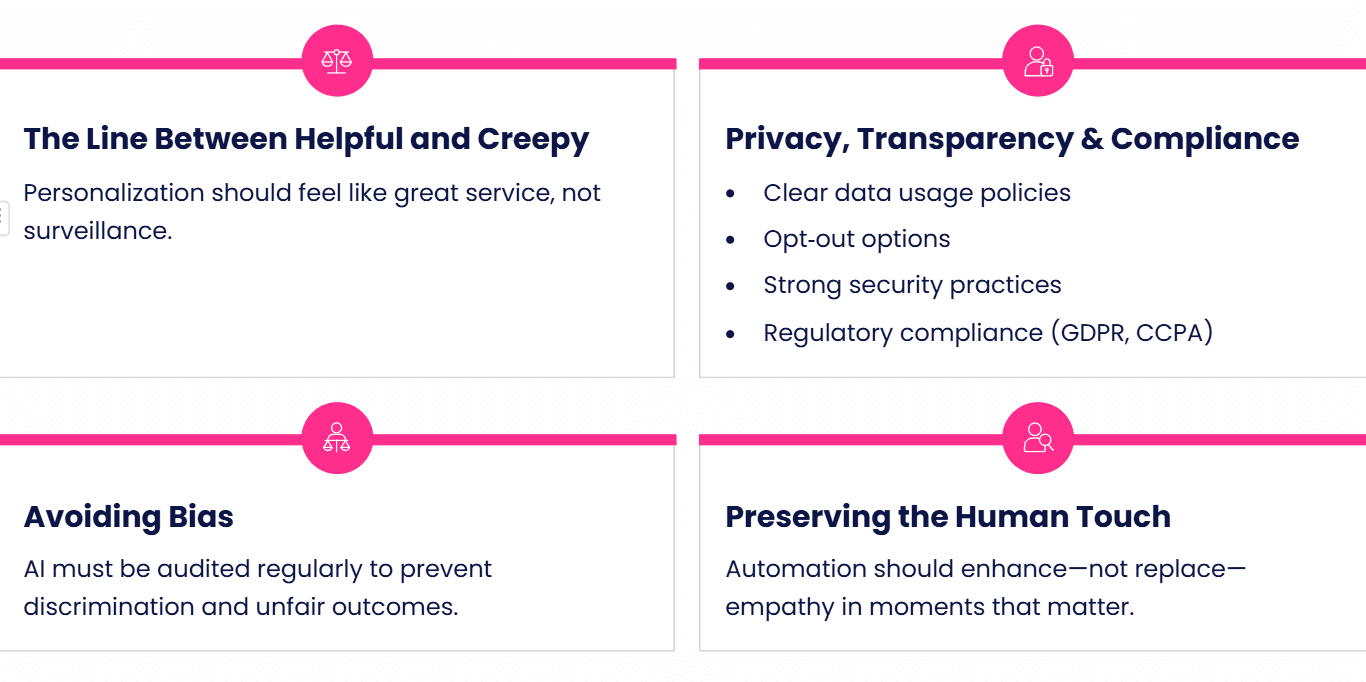
Below are four ways to ensure that you are ethically responsible with your personalization marketing efforts.
An Implementation Guide for Leaders
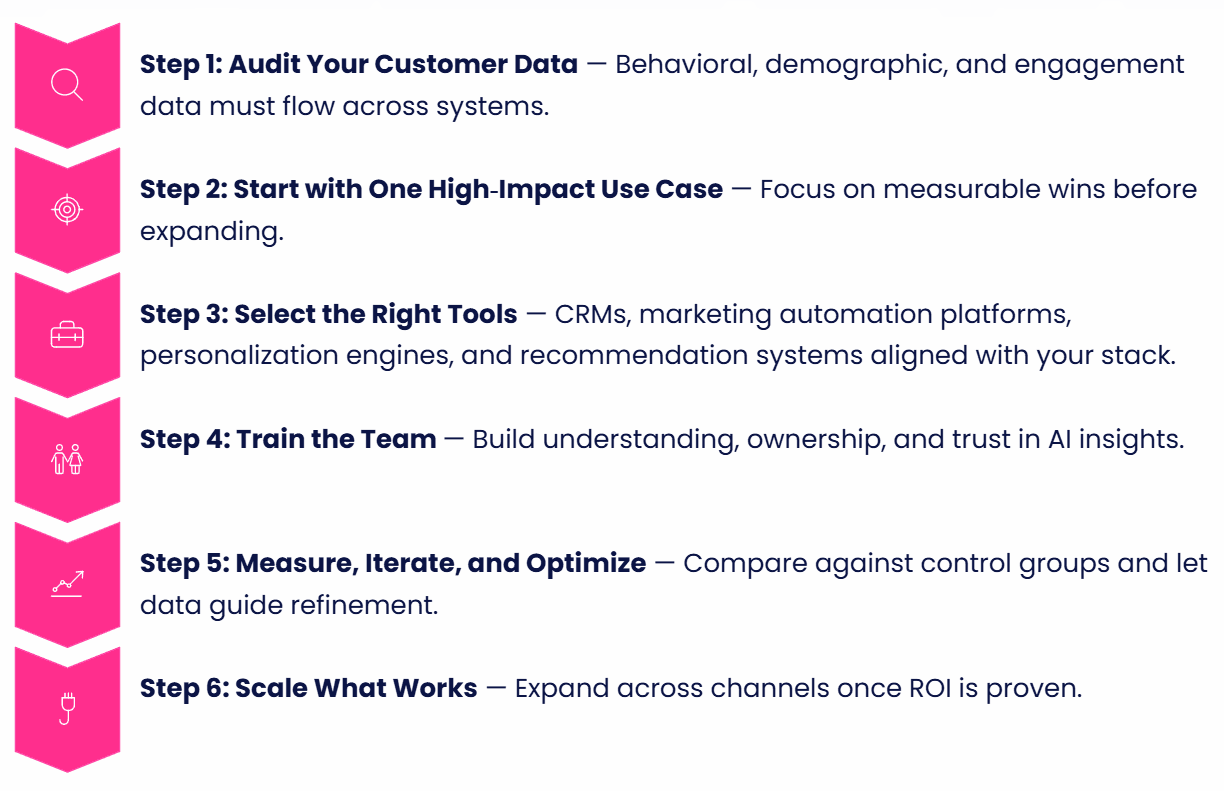
We use a six-step process whenever we embark on any personalization initiative with a client.
Personalization or Bust
AI‑powered personalization is no longer optional. Your customers expect you to know them. Leaders who invest now will create experiences that feel intuitive, relevant, and human at scale.
Those who delay will struggle to catch up.
The technology is there. The ROI is proven. The expectation is set.
Don’t wait – your customers are worth it.
Ready to implement AI‑powered personalization that drives real results? We help executives design and execute data‑driven personalization strategies that scale.
Reach out to us today.