
The AI Explosion in Marketing
Over the past two years, marketing teams have experienced one of the fastest technology adoption cycles in history.
According to Sci-Tech Today, the global Generative AI market – which has doubled in the past two years – is projected to grow from USD $55 billion in 2026 to over USD $1 trillion by 2034.
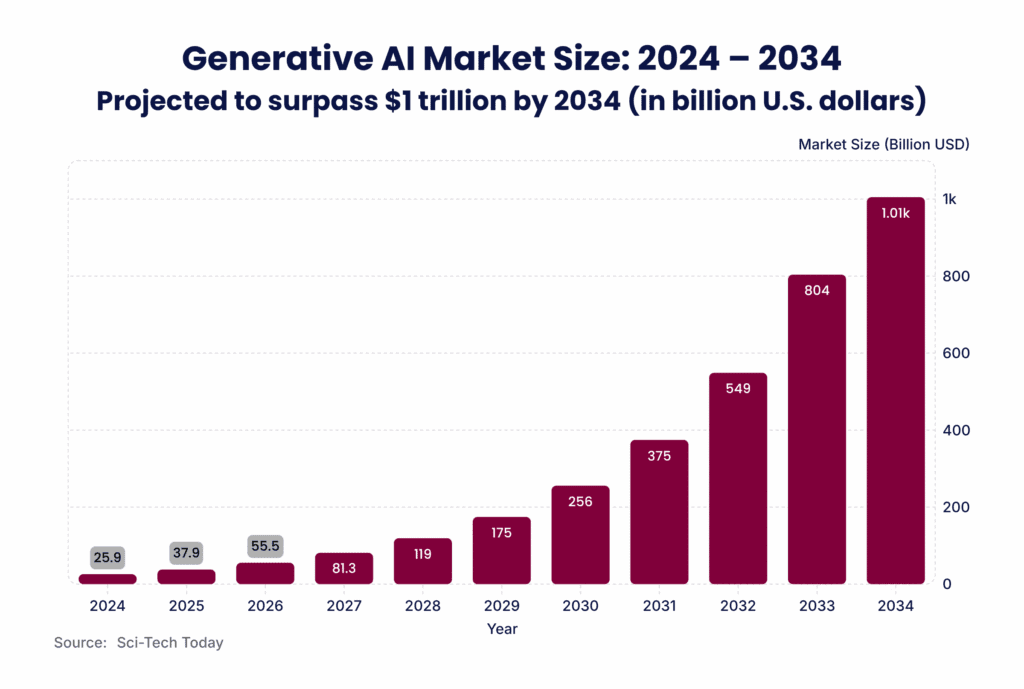
Over 1 billion people are using generative AI today.
Across all major AI mobile platforms, ChatGPT dominates by a wide margin with 557 million monthly active users — nearly 8X its closest competitor.
At 70% of all combined monthly active users, ChatGPT has a commanding lead that underscores its position as the defining platform of the current AI era.
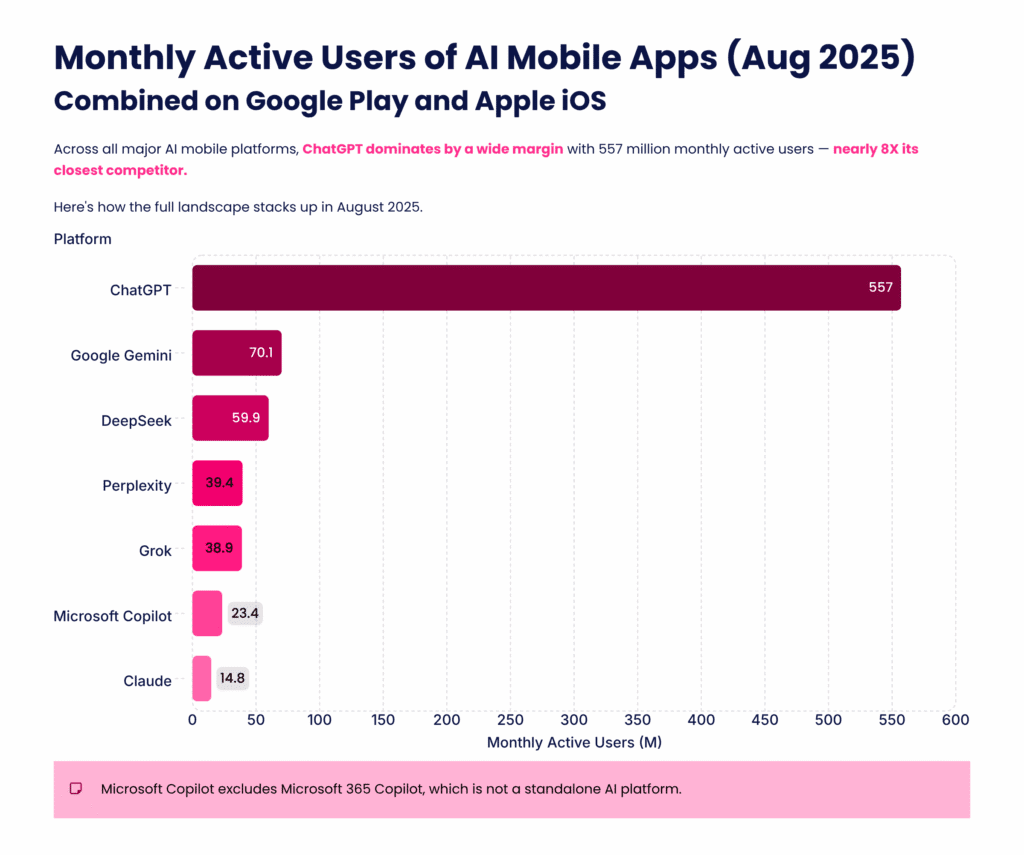
Source: SimilarWeb App Intelligence, October 2025
Across the marketing tech stack, AI tools are now used as:
- Content generators
- Sales assistants
- Analytics copilots
- Customer intelligence platforms
And adoption is happening quickly:
- 88% of marketers rely on AI in their jobs (Source: SurveyMonkey Research),
- 60% of marketers use AI tools daily, up from just 37% in 2024 (Source: Social Media Examiner), and,
- 97% of content marketers use AI, up from 83% in 2024 and 90% in 2025, making it the #1 marketing use case after chatbots (Source: Siege Media).
Yet when I talk with marketing leaders, I hear the same thing:
“We’re experimenting with AI…..but we’re not seeing meaningful business impact yet.”
Why does that not surprise me?
Because most organizations are still in AI experiment mode, not AI system mode.
Experimentation Is Easy. Systems Are Hard.
Testing AI tools is relatively simple.
A marketer can open ChatGPT, generate content, test prompts, or use AI features inside a CRM or marketing platform.
But experimentation doesn’t automatically translate into operational change.
Research shows that while AI adoption is widespread, only a small percentage of teams have fully integrated it into their workflows. For example, according to SAS, 85% of marketers report are using generative AI, but only about 15% say it is fully integrated into their daily workflows.
In other words, teams are using AI, but they haven’t operationalized it yet.
Real AI impact happens when AI becomes part of the system, not just the workflow of an individual marketer.
That means integrating AI into your:
- CRM platforms
- marketing automation systems
- personalization engines
- lead intelligence platforms
- customer engagement workflows
Without this integration, AI remains a series of disconnected tools rather than a capability embedded in the business.
The Operational Gap
This is where most organizations get stuck.
They have AI tools, smart teams, and strong marketing strategies, but they lack a structured approach to implementing AI across the revenue system.
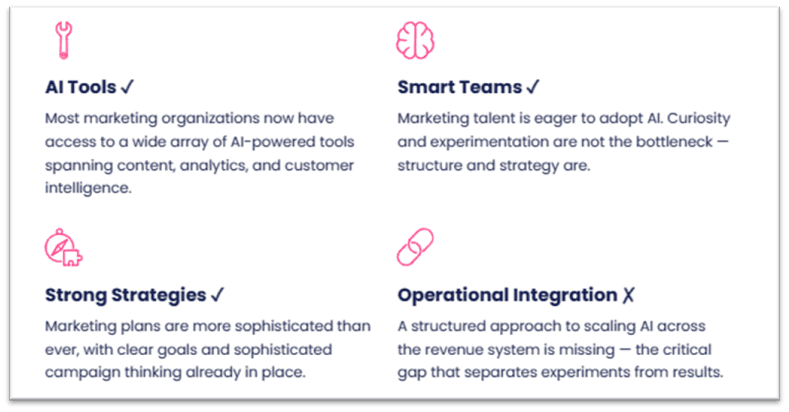
The result?
AI becomes a collection of experiments instead of a coordinated capability.
This gap is not unique to marketing.
A 2025 global survey by McKinsey found that while AI adoption is growing rapidly, most organizations are still struggling to scale AI beyond isolated pilots.
Marketing is experiencing the same pattern: Tools are everywhere. Operational integration is rare.
Moving From Experiments to Systems
The teams that are seeing real impact approach AI implementation differently. Instead of starting with tools, they start with systems thinking.
We approach AI strategy in three stages:

Define à Identify the highest-impact opportunities where AI can improve decision-making, efficiency, or customer engagement.
Design à Map workflows where AI can be integrated with existing systems such as CRM platforms, marketing automation, and data infrastructure.
Deploy à Implement and refine AI-powered workflows that support real operational outcomes.
This shift, from isolated experiments to integrated systems, is where AI begins to drive measurable value.
Where Marketing Leaders Should Start
For marketing teams exploring AI, the most valuable starting point isn’t tools.
It’s workflows.
Look for areas where you’re spending significant time:
- research and insights
- personalization and messaging
- lead intelligence and qualification
- content development
- campaign optimization
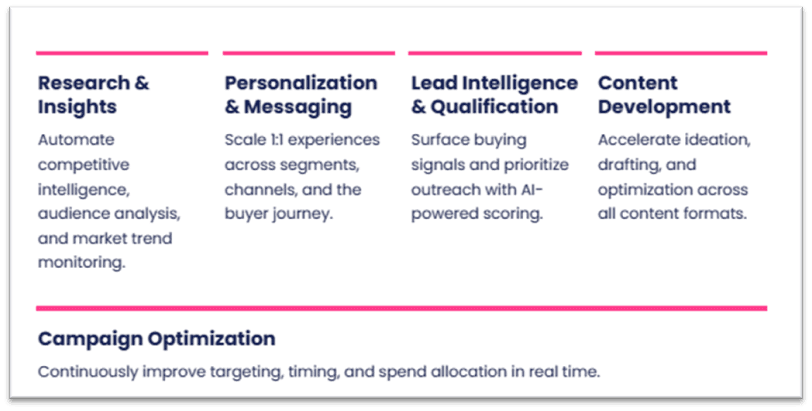
These are often the places where AI can deliver the fastest and most meaningful improvements.
AI-driven personalization and campaign optimization will likely have the biggest impact on marketing performance in the next few years. But, important to note, personalization only works when AI is connected to the underlying customer data and marketing systems that power engagement.
Conclusion: AI Revenue Systems
The first wave of AI adoption was about tools. The next phase will be about systems.
Organizations that succeed won’t simply adopt AI faster.
They’ll integrate AI more thoughtfully into the way their revenue engines operate.
That means connecting AI across:
· data
· systems
· workflows
· decision making
Because that’s where the real transformation happens.
If you’d like a FREE STRATEGY CALL to discuss how you can build your own INTEGRATED AI REVENUE SYSTEM, book a call today with our founder, Stacey Wisniewski HERE.